Greetings from Panama! My name is Marina Ehrman and I have been a professional tour guide and promoter for Panama Tourism and Travel Company since 2005. I love what I do and am proud to share what my country has to offer. It is filled with endless leisure and commercial attractions, friendly happy people who open their doors to all visitors. Panama is a country of incomparable natural beauty with a variety of tourist attractions, beautiful beaches in the Pacific and Caribbean. The tropical climate year round with its diversified flora, fauna and indigenous groups make it one of the most important of Ecotourism in Latin America.
I invite you to know our country’s history, culture and also enjoy the cuisine, folklore and traditions that only a place in the world can provide………Panama!
Contact me and I’ll organize your visit and will be happy to welcome you in Panama. For more information on Panama, follow my Facebook page and my blog. Visit www.panamatourismtravel.com
Hospital Point is a close and small place with a great diversity of attractions part of Solarte's island. Tourists can scuba dive or snorkel in the reef nearby, or swim and rest in the protected small beach, know about the history of the islands with the owner of the point or walk in the forest with a local guide, looking for the tiny colorful and poisonous frogs and the tombs from the beginning of the century.
Christopher Columbus sailed in front of the island during his fourth voyage in 1502.As english-speaking bucaneers, pirates and colonists, came during the next three centuries the island became known as Nancy's Cay. In United Fruit Company medical files from 1899 to 1920, "Nances Cay", is used. The Spanish name of the island is Solarte.
Towards the end of the 19th century, the banana business prospered and people from different countries came to the islands to take advantage of this new industry.
Several banana companies operated in Bocas del Toro during the last years of the 19th century. In 1899 the giant United Fruit Company replaced all other banana interests in the region, establishing their main office in the city of Bocas del Toro. To ensure a healthy and functional work force, the company built a Medical Center on the west end of Solarte, a place that came to be known as Hospital Point.
The history of the hospital is very rich. Plants lovers find, in the western side or Hospital Point, where the main house is, a real botanic garden with species from all over the world, with emphasis in a diversity of banana plants.
Today, visitors can appreciate the remains of concrete columns and sidewalks of the complex. In the nearby forest are several tombs, some identified and others not. In the sea, snorkellers and divers can appreciate the history of Hospital Point in the form of rails, ceramic and bottles
About a 10 minute boat ride from Bocas town gets you to the Red Frog Marina, from where a 15 minute hike across the narrowest point of Bastimentos Island allows you to reach Red Frog Beach. With 0.75 miles of white and golden sand, Red Frog Beach is one of the most popular beaches in Bocas del Toro.
The north shore of Bastimentos Island hosts some of Bocas' most beautiful beaches and Red Frog is one of the more accessible ones, and the only one with a few facilities such as a couple of restaurants and bathrooms. It receives its name from the poison-dart frogs that are abundant in Bastimentos' hills. If you're lucky enough you might encounter a three-toed sloth or some monkeys as well.
Due to its ease of access many boat tours make Red Frog Beach their last stop during the day, providing you with a lively environment with travelers from all over the world (anything between 100 and 300 people). During low season, it is a lot quieter. If you happen to arrive to Red Frog and feel the need for more space to yourself you can always hike a bit to the east (Turtle Beach) or to the west in direction to Wizard Beach (Playa Primera), or simply go to another beach in Bocas del Toro with less people... there are loads of secluded beaches in Bocas
Located on the south-eastern border of the Bastimentos National Marine Park, the Zapatillas Cays are two stunning islands that emerge from a coral platform and are surrounded by tropical coral reef. About a 30 minute boat ride from Crawl Cay (roughly 8 kms), the Zapatillas Islands are generally considered the most beautiful islands of the Bocas del Toro Archipelago and offer visitors pristine white sand beaches, crystal clear turquoise waters and some of Panama's most attractive coral reefs.
Some say they receive their name from a fruit that grow in its forests, and yet others because their shape resemble a pair of running shoes ("zapatillas" in Spanish).
Western Zapatilla or "Zapatilla Menor", is less than half the size of its eastern counterpart, and is nesting ground for the Green Marine Turtle. Leatherback and Hawksbill Turtles lay their eggs on both islands. This island is more visited by scientists than by tourists.
Eastern Zapatilla or "Zapatilla Mayor" is home to the ranger station (the rest of the cays are uninhabited), where a $10 Park Fee is collected from visitors . The best snorkeling and diving in Major Zapatillas can be found towards the south-eastern coast, about 300 meters from the beach in a spot known as Coral Islands. This spot is relatively shallow and has the most beautiful coral
formations with lots of tropical fish, and its crevices hide many lobsters, crabs, eels and an immense amount of tiny sea invertebrates. If you want more than a just a gorgeous reef, on the Zapatillas' north shore, you can go behind the breakers (the reefs that break the incoming waves... when there are waves). If the sea permits (mainly May, September, October), you will find a wall formed by the reef, that contains small caves and tunnels, up to 40 feet deep.
All of the beaches on the islands are excellent for swimming, and there is a rough 45-minute nature trail that makes its way through mangrove swamp. With some difficulty, you can complete the circuit through the center of the island and return along the beach.
One of the most famous snorkeling spots in Bocas de Toro, Crawl Cay is a tiny island located in the channel between Bastimentos and Popa Island (about 20 minutes by boat from Bocas town, or 10 - 15 minutes from Dolphin Bay). Crawl Cay is surrounded by lush coral gardens, the best of which begin just after the south-eastern tip of Bastimentos Island
The sea here is calm year-round, which make it suitable for snorkelers of all ages, and the abundance of tropical fish, coral heads and colorful sponges will keep experienced divers entertained as well. Water clarity is better than at other places but as always it depends on if it's rained during the previous days. On the typical Caribbean day with lots of sunshine and light blue skies, the waters of Crawl Cay are of luminous emerald green shades and make the perfect holiday postcard.
The Archipelago of Bocas del Toro is home to a semi-permanent population of Bottlenose dolphins. Its calm waters and abundance of small fish, crustaceans and squid seem to make the perfect grounds for the young ones' first stages of life. Calves and juveniles can be frequently spotted with their mothers, as well as small pods of 5 or 6 dolphins.
The dolphins of Bocas del Toro seem to have a special predilection for the bay locally known as Laguna Bocatorito (Dolphin Bay), which is about 12 km south of Bocas town (about 15 - 20 minutes by boat). This bay is bordered by the east side of Cristobal Island and an odd-shaped peninsula from the mainland. A labyrinth of shallow channels formed by mangroves screens its northern entrance, helping to make it a kind of giant natural aquarium, six kilometers across at its widest.
Famous for its abundance of starfish (you will literally encounter hundreds of them in this beach), Starfish Beach is a must visit destination of the Bocas del Toro Archipelago. Starfish beach is located on Colon Island, on its north-western side (opposite side of Bocas Town). Even though it can be reached by bus from Bocas Town (30 minutes), most tours that visit Bird Island (about 30 minutes from Bocas Town by boat) make a stop at this beach, either before or after lunch. It's about a 20 minute boat ride back to town from Starfish Beach.
Due to its location, its waters are very calm during most of the year, except during certain times in November and December when the swell comes up from the north. Its crystal clear waters and abundance of starfish make it a big favourite amongst visitors of all ages. Definitively one of the most beautiful beaches in Bocas del Toro.
Swans' Cay, also known as Bird Island is birders paradise. Here you will find the only known nesting place in the Caribbean of the Red-billed Tropic Bird (Phaeton aethereus). Swans Cay is a rocky formation approximately 70 meters long, with a rounded quarter moon shape, pierced by two openings through one end, and rises 55 meters at the highest point. On the southern side, sheltered from the northeastern trade winds, there is a small sandy beach below a higher level area. Bushes and other vegetation cover the summit, and there is a small clump of coconut palms at the low end. A designated bird sanctuary, Isla Pajaros, also has brown booby (Sula leucogaster etesiaca), the brown pelican (Pelecanus occidentalis carolinensis), the frigate (Fregata magnificens) and many types of gulls and terns.
The Isla Morada is surrounded by a fascinating history, long before transporting tourists across the Panama Canal. It was designed as a luxury megayacht for Boston millionaires. It was Built by Lawley & Sons, the company Cox & Stevens. All in wood, was built in the shipyards of the East Coast of the United States, and began sailing in 1912 with the name Santana. It had five luxury bedrooms, a lavish dining room, a library and was home to a crew of seven sailors. Among its owners was a very special one, the most famous gangster in history, the legendary Al Capone.
In the years of World War II it was requisitioned by the United States Navy, later to be acquired by a sailor who lived in Florida, which re-christened with the name of Isla Morada. It arrived in Panama in 1960 and served as a hotel ship anchored off Piñas Bay during the construction of the Tropic Star Lodge, the world famous sport fishing resort.
With capacity for 100 people, complete sets of Signs and Lighting, Help Communication System, Navigation lights properly installed and operational, and Fire Systems First Aid Kit. The conditions of the hull, machinery and electrical installations are periodically reviewed and are appropriate for making the spacecraft trajectories.
The ship has the following life-saving appliances:
6 bags with capacity for 132 lifeguards people.
Life jackets for 165 people.
Its dimensions are:
Length (L): 96.00 mts.
Beam (width): 19:00 mts.
Depth (draft): 5.00 mts.
Gross tonnage: 94.00 tons
The second boat we have is the Fantasia del Mar with a capacity for up to 434 people.
It was built in Booth Bay Harbor, Maine, E.U.A. by Eastern Shipbuilding Corp.
The Fantasia del Mar has the following life-saving appliances:
22 bags jackets with a total capacity of 440 people
Life Jackets for 440 people
Its dimensions are:
Length (L): 35.66 mts.
Beam (width): 8.69 mts.
Depth (draft): 3.23 mts.
Gross Tonnage: 465.14 tons
The third and last boat is the Tuira II with a capacity for up to 492 passengers with 2 spacious floors.
It was built in the USA by Willey Manufacturing Co.
The ship has the following life-saving appliances:
The main plaza in Old Panama occupies an important place in
the history of Latin American urban planning as one of oldest such space.
The quadrangle of Old Panama´s main plaza is small and
slightly trapezoidal in shape. Records indicate that in 1671 it measured approximately
69 x 57 meters, a very modest size in comparison to the huge plaza subsequently
laid out in Mexico and the Andean region. The archaeological excavation
conducted a decade ago suggest the the original plaza was even smaller as the
block on the north side, corresponding to the so-called Terrin houses, was
reduced in size in the early 17th century , thus providing 500 m2 of additional open
space .
The plaza is presided over by the cathedral tower, located
more or less at the center of the east side. Right of the cathedral stad the
ruins of the old cabildo or council, a small building that had a two stored
arade. the terrin house also had an arcade .On the west side was a row of wooden house,while the south side, where the prision is
thought to have been located, is buriedbeneath a modern building
The King's Bridge ( Puente del Rey) has legendary fame in Panama , comparable
only to the cathedral tower in Old Panama. It is not only the best preserved
bridge from the colonial period in the country but it also represents the spot
where the Royal Road commenced, along which passed the mythical riches of Peru
in route to Portobelo.
For a hundred years there was a wooden bridge over the
River Abajo- the north terminus of Old Panama but in 1619 building works
commenced on the present day stone structure , which has a single semicircular
arch with exquisite worked ashlaring. No one knows when the bridge was
completed, but apparently construction works lasted for years .
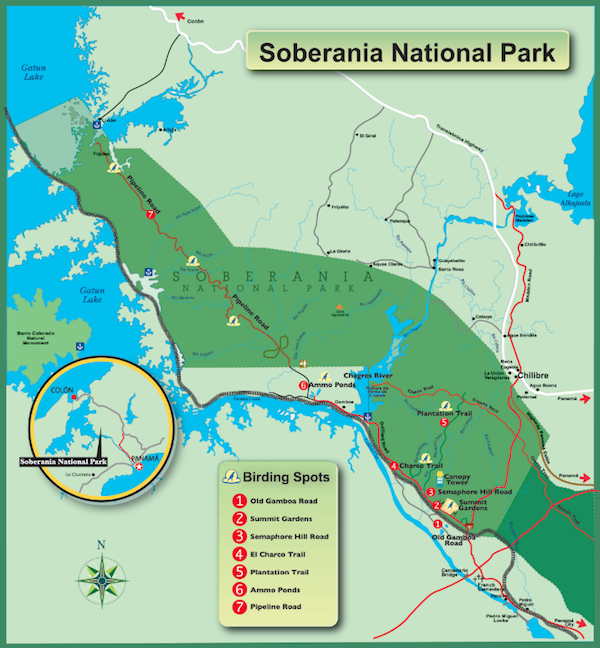
Soberania National Park is located within Colon Province and Panama Province. It is about 40 minutes from Colon, and 20 minutes from Panama City. Established as a national park in 1980, the park covers 55,000 acres (220 km2) The Charges River flows across the national park at the town of Gamboa.
There is a park headquarters with rooms for meetings and
audiovisual presentations, a store, orchid site, and natural trails. In Aguas
Claras there is a checkpoint and a forest ranger facility. There are three
natural trails: the Charco, the Camino de Plataciones and Camino de Cruces. In
the protected area there is a camping area. There 105 species of mammals, 525
species of birds, 79 reptiles, 55 amphibious and 36 species of fresh water fish,
so the park is an important wildlife refuge.
The jewels of the park are Trail el Charco in Gamboa and the
bird observation sites along Pipeline Road ( Camino del Oleoducto). The Camino de Cruces also
crosses the park. This was the road that the Spanish used to transport gold
overland from the Pacific to their ships in the Caribbean. Part of the paved
section has been restored.
The annual mean temperature is 28º C the Caribbean slopes of the
park. Rugged undulating hills and steep slops prevail, with a maximum height at
Cerro Calabaza (85 meters above sea level).
The Park is made up of humid forest with its impressive trees
like, cotton tree (ceiba), cuipo (Cavanillesia platanifolia), mahogany and
guayacan (Tabebuia guayacan). The forest contains lots of lianas, epifitas and
orchids and the royal palm tress, fruit trees nance (Brysonima crassifolia), and
wild plums.
Birds are particularly noteworthy here. On its
best known trail, the Pipeline Road, the Audubon Society has for 19 years held
consecutive world records in the annual census it organizes. 525 species of
birds were recorded on just one day in 1996. Among the outstanding ones are the
endangered crested eagle, the spectacular rofous-ventaul, ground- cuckoo, and
colorful tragons like violaceous tragon, motmots, toucans, trogons, flycatchers, antbirds, woodpeckers, tanagers, and hawks. Among the rare bird species in the park are yellow-eared toucanets, crimson-bellied woodpeckers, sirystes, and rarely seen harpy eagles
Reptiles such as the babilus, the warty snake,
amphibians such as the common toad or the salamander and fresh water
fishes like the sabalo, pipon or the barbudo are to be found
here
Portobelo National Park is located within Colon Province. It is made up of 86,000 acres, 20% of which are marine areas. It protects both coral reef communities and coastal forest. This coastline includes important stretches of coral reefs, mangrove swamps, coastal lagoons and beautiful beaches, where every year four species of marine turtle, including the threatened hawksbill, come to nest. Within the park is one of the more beautiful natural harbors of all Caribbean, the bay of Portobelo. The fortifications that are conserved surrounding the cove were named by UNESCO as a World Heritage Site in 1980. This means that the bay of Portobelo has been included on the list maintained by the international World Heritage Program administered by the United Nations Educational, Scientific and Cultural Organization World Heritage Committee, whose goal is to preserve sites of outstanding cultural or natural importance to the common heritage of humankind.
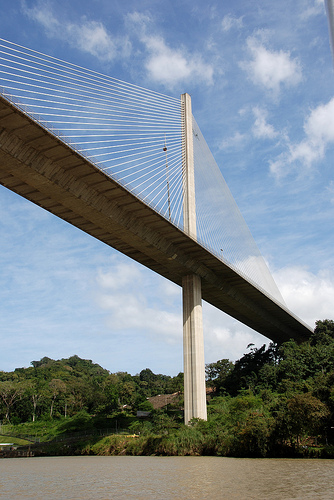
The Centennial Bridge is one of only two major bridge crossings over the Panama Canal. The other major crossing being the Bridge of the Americas. Two small service bridges stretch across the Panama Canal at the Miraflores Locks and Gatun Locks; however these crossings can only be used when the lock gates are closed. The Centennial Bridge opened in 2004 and was constructed to alleviate the traffic on the Bridge of the Americas and replace it as the route of the Pan-American Highway.
The bridge was named for Panama's centennial, which occurred on November 3, 2003. The Centennial Bridge crosses the Panama Canal at the Gaillard Cut near the Pedro Migual locks and is about 10 miles north of the Bridge of the Americas.
Bocas del Toro Archipelago: a quick flight from Panama City is the best way to arrive at this unique, Caribbean-style archipelago. This could be Panama's most famous tourism destination. Fabulous snorkeling, laid back vibe and unique water taxi community all make Bocas a site worth seeing.
Isla Grande: an island off the coast of Portobello offers incredible snorkeling, coral reef and calm waters. There are also some surf breaks
Guna Yala Islands: the famous Guna run islands are one of Panama's most recognizable locations. Culturally rich, the thatched hut mini-hotels are unchanged by time. Tourists love this destination for the adventure of living as the Gunas live: simply, and in an island paradise
After an exciting day on the water, we encourage you to take a stroll on the many islands white sand beaches, or take our kayaks out in search of bottlenose dolphins and flying fish. The islands in this area boast on of the richest varieties of bird life in the world. Take a guided tour through the jungle on Coiba Island in search of leaf cutter ants, exotic insects, and the occasional sloth. You may even see howling monkeys or hear their call during the end of the day. Whatever activities you choose, your experience in Panama will be one you will not forget.
Cruising
Cruising in and out of the islands that separate the open ocean from inside waters on the west side of Panama is truly something spectacular. This is a place with white sand beaches and clear blue water, where fishermen still paddle out in hand carved canoes to their fishing grounds. This area is protected by the Coiba National Park and the Cerra Hoya National Park. Both parks are a refuge to birds, a variety of animals, reptiles, native flora and fauna, reef, and, of course, fish. Immerse yourself in the tropical experience and take a step back in time. This is the Lost Coast.
Surfing
Surfing is a must for beginners and experts. It is rare to find quality waves without anyone on them. Let our experienced guides take you to the right wave for you. With over 10 waves that we go to frequently, and an additional 14 locations that depend on swell size, wind and tides, there is sure to be one wave that is ideal for you. Our guides will be able to instruct you on the best way to surf each spot and can also teach beginners. You can combine surfing with other activities in one day. The opportunity to combine different activities is what Lost Coast Excursions is all about - the next activity is just a short boat ride away.
Snorkeling
Snorkeling in the park is something that should not be missed. You will see a rich variety of tropical fish, small reef sharks, beautiful corals and at times manta rays. Snorkeling with the whale sharks is also something that is possible given the right conditions. We have snorkeling equipment on the boats, ready for you.
Jungle Tours
In the Coiba National Park there is a spectacular jungle tour that is available to you at any time. You can do a half hour tour or does a full day hike through Coiba Island. Coiba Island has a multitude of indigenous species of plant life, animal life, reptiles, and bird life that you cannot find anywhere else in the world. The Smithsonian has a research center in the park that allows them to study these unique species. Please bring closed toed shoes if you would like to do this tour.
Ocean Fishing
The waters of Coiba National Park offer some of the best fishing in the world. During your trip, we will target cubera snapper and roosterfish, and will have opportunities at blue marlin, black marlin, and yellow fin tuna.
Inshore Fishing
With the use of a jet sled we can travel up rivers and fish estuaries with ease, so that you can cast flies or lures for all types of inshore species. Snook, roosterfish, snapper, and bonito are all a blast on light tackle.
Whale and Dolphin Watching
Blue whales, Humpback Whales, Pilot Whales, Whale Sharks, and many kinds of dolphin can be and are often spotted in the park. We encourage you to bring your camera on all outings!
Beach Tours
Any of the white sand beaches you see can be yours! The cabanas have a white sand beach out the front door. We can also visit Isla de Oro and other perfect white sand beaches if you would like. Bring an umbrella, the snorkeling gear and beverages and make it a day to remember.
Local Village Tour
We will pass by several small fishing communities that have no road access. Entering these small settlements is like stepping back in time. Witness groups of men hand carve their fishing canoes from whole logs. See people fish from the bank of a river with bamboo poles or casting line. Life in these villages revolves around the catch of the day.
Bird Viewing
These areas have a unique variety of bird life that can be viewed from the ocean or on jungle tours. Panama has over 10 birds that are endemic to Panama. Take advantage of your opportunity to see the rare Coiba Spinetail, which is not found anywhere else in the world.
The adventure tour is a unique opportunity to take advantage of all that Coiba National Park has to offer.
For those who do not know, this flower is called the Flower of the Holy Spirit and is the national flower of Panama. It blooms between july and October. You can find it near rivers and streams in a very humid environment. It is white (ivory) and seems to have a little dove in its center.
During Anton Valle Tour you can see one of these exotic flowers BOOK NOW
Mention Isla Coiba to the average Panamanian and treasured marine park and abundant ecosystem are probably not the image that pops into their mind. For modern day citizens of Panama, stories of imprisonment, torture and death are more like to come to mind.
Coiba Island was Panama’s version of Devil’s Island. From 1919 to 2004, the penal colony on Isla Coiba was home to the country’s most dangerous criminals as well as home to many who found themselves on the wrong side of the political struggle. At its peak, The Coiba Island Prison housed 3000 inmates in about 30 camps spread around the islands.
“Los Desaparecidos” was the name given to the hundreds or even thousands who disappeared in Panama under dictators Omar Torrijos and Manuel Noriega, never to be seen again. It is believed that many of these unfortunate individuals either ended up in unmarked graves near the Coiba’s penal colony or to have been dismembered and fed to the abundant shark population in its surrounding waters.
After the fall of the dictatorship, Coiba resumed its role as a criminal prison camp rather than political prison. In its final days, prisoners were the run of the mill thieves, murders and rapists serving their debt to society by farming and ranching the island to provide for their own existence.
The prison is now closed. The prisoners have been relocated to other facilities and anything of value has been removed from the site. The remaining structure is slowly being reclaimed by jungle and the marine air. Its crumbling buildings and simply marked graves serve as the only memorial to Coiba’s dark history.
The fear of the prison and its inhabitants inadvertently resulted in preservation of the largest untouched rain forests in the Americas. Because of the deterrent of the penal colony, about 80% of the islands forest remains virgin and unmolested. A true silver lining in one of man’s most horrible moments. Of course, with the prison gone and the supervising staff woefully under funded, Coiba’s next challenge is fending off poachers preying on the abundant wildlife of the park.